26 10, 2020

Steel Services and Pre-painted Steel: Over 50 Years of Steel Processing Expertise

2020-10-26T18:27:08+00:00October 26th, 2020|News Blog|

As a leader in supply-chain management, optimal supply solutions, process & product analysis, just-in-time inventory, and customized solutions to meet customer needs, National Material Company is the ideal choice for any customer in search of the best experience possible. A committed workforce, state-of-the-art processing equipment and warehouse storage capabilities make NMC the company to count on for future success. Locations throughout the U.S. offer a logistic advantage resulting in a more efficient service to conserve our customer’s most valuable resource: cost.

National Material Company not only provides the best practices in the industry, but also offers insights into transforming process into profit. NMC creates value through seamlessly integrating improvements at every step: from initial value engineering to final product delivery. That means if there is a way to improve quality and efficiency, NMC will help you find it.

It’s no wonder that their clients report significant savings as a result of the NMC’s VA/VE insights.
National Material Company’s steel processing services include pre-painted steel, slitting, blanking, cut-to-length, leveling, export packaging, rail and barge shipping and receiving, scrap programs, configured blanks, stamping press tooling needs, complete mechanical and metallurgical testing/metallurgical technical services, pickling, oiling, and dry-lube and hot dipped galvanizing. Client: Leading manufacturer of HVAC and refrigeration compressors
Savings: $475K annually
NMC Contribution: Increased material utilization and reducing scrap by purchasing wider pre-painted steel master coils and improved nesting configurations.

Client: Large producer of recreational vehicles
Savings: $1 Million
NMC Contribution: Modification in purchasing to acquire fully finished, pre-painted master coils.

Client: Large refrigeration tubing company
Savings: $1 Million
NMC Contribution: Leveraged National Material Company’s global sourcing capabilities combined with their in-house metallurgical expertise to develop a specialty cold rolled steel. Client: Producer of extruded aluminum roll-up awning tubes
Savings: $750K
NMC Contribution: Introduced a highly flexible paint system continuously coil-coated over a formable hot dip galvanized grade of flat rolled steel.

Client: Leading manufacturer of HVAC and refrigeration compressors
Savings: $1.5 Million
NMC Contribution: Leveraged National Material Company’s logistics capabilities. The steel for this application is now melted, hot rolled, pickled/lubed, and circle blanked all within the same state prior to being delivered to our customer’s plant location.

Client: Garage door manufacturer
Savings: $100,000 annually
NMC Contribution: Developed a special grade of hot dip galvanized steel.

Why National Material Company?

It is the appreciation of all moving parts that will make a client’s final product a commercial success. With expert supply chain management, just-on time delivery, and access to all the right partnerships, NMC can deliver the right steel at the right time. About National Material L.P. – Since its founding in 1964, National Material Limited Partnership has grown to over 30 business units and is now one of the largest suppliers of steel in America. The National Material group of industrial businesses consists of the Steel Group, Stainless and Alloys Group, Raw Material Trading Group, Aluminum Group, and Related Operations.

Please visit us at www.nationalmaterial.com or call (U.S.) 847-806-7200 to discuss how we can be of service.

15 07, 2020

Steel Breakdown: Types, Classifications, and Numbering Systems

2025-02-24T17:14:18+00:00July 15th, 2020|News Blog|

Metal processing machinery with orange sparks flying off in a spiral-like motion

In this blog, we will take an in-depth look at some of the most common categories of steel, what makes them different, and what to consider when deciding which type of steel is right for you.

Enhance Your Projects with Expert Steel Processing Solutions

Four Types of Steel

According to the American Iron & Steel Institute (AISI), steel can be categorized into four basic groups based on the chemical compositions:
1. Carbon steel
2. Alloy steel
3. Stainless steel
4. Tool steel

All steel is composed of iron and carbon. It is the amount of carbon, and the additional alloys, that determine the properties of each grade. There are many different grades of steel that encompass varied properties. These properties can be physical, chemical, and environmental. Let’s take a closer look!

Carbon steels contain trace amounts of alloying elements and account for 90% of total steel production. Carbon steels can be further categorized into three groups depending on their carbon content:

● Low carbon steels/mild steels contain up to 0.3% carbon
● Medium carbon steels contain 0.3-0.6% carbon
● High carbon steels contain more than 0.6% carbon

Alloy steels contain alloying elements (e.g. manganese, silicon, nickel, titanium, copper, chromium, and aluminum) in varying proportions in order to manipulate the steel’s properties, such as its hardenability, corrosion resistance, strength, formability, weldability, or ductility. Applications for alloy steels include pipelines, auto parts, transformers, power generators, and electric motors.

Stainless steels generally contain between 10-20% chromium as the main alloying element and are valued for high corrosion resistance. With over 11% chromium, stainless steel is about 200 times more resistant to corrosion than mild steel. These steels can be divided into three groups based on their crystalline structure:

Austenitic: Austenitic steels are non-magnetic and non-heat-treatable, and generally contain 18% chromium, 8% nickel, and less than 0.8% carbon. Austenitic steels form the largest portion of the global stainless steel market and are often used in food processing equipment, kitchen utensils, and piping.
Ferritic: Ferritic steels contain trace amounts of nickel, 12-17% chromium, less than 0.1% carbon, along with other alloying elements, such as molybdenum, aluminum, or titanium. These magnetic steels cannot be hardened by heat treatment but can be strengthened by cold working.

Martensitic: Martensitic steels contain 11-17% chromium, less than 0.4% nickel, and up to 1.2% carbon. These magnetic and heat-treatable steels are used in knives and cutting tools, as well as dental and surgical equipment.

Tool steels contain tungsten, molybdenum, cobalt, and vanadium in varying quantities to increase heat resistance and durability, making them ideal for cutting and drilling equipment.
Steel products can also be divided by their shapes and related applications:

Long/tubular products: These include bars and rods, rails, wires, angles, pipes, and shapes and sections. These products are commonly used in the automotive and construction sectors.

Flat products: These include plates, sheets, coils, and strips. These materials are mainly used in automotive parts, appliances, packaging, shipbuilding, and construction.
Other products […]

15 06, 2020

How to Choose Your Toll Processor

2020-07-15T20:49:18+00:00June 15th, 2020|News Blog, NMC Media|

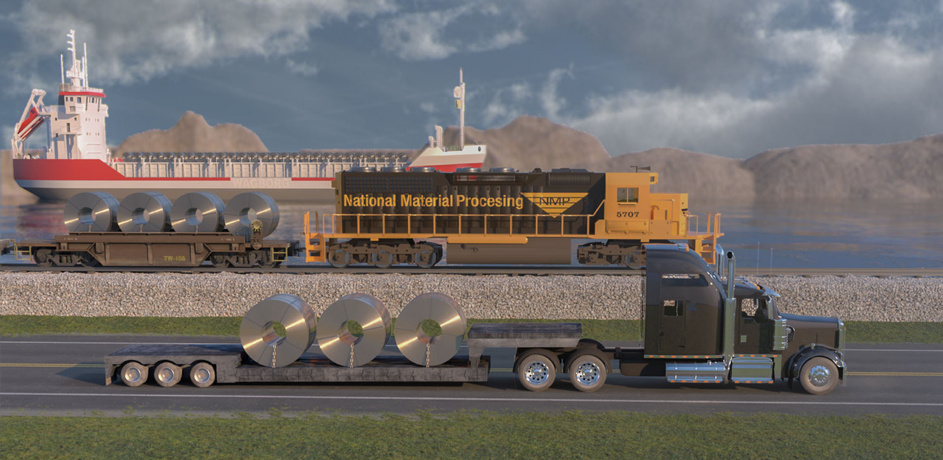
3D rendering of various modes of transporation delivering steel coils.

Toll Processing and Cost Efficiency


Toll processing can be defined as performing a service on a customer’s product for a fee. In other words, the steel mill, end-user, or trading partner will make or purchase the material and ship the product to a processing facility. The processor will then work the material according to the customer specifications, then deliver the processed material to the destination directed by the customer.

The concept of outsourcing business support is a trend that is gaining in popularity. Company owners are making the decision to utilize toll processors primarily because it’s cost efficient. A materials processing service provider can move a project from the development stage all the way to full scale production. Also, a growing business might lack the facilities, manpower, storage space, or time required to process the necessary materials for their products, leading to shortfalls in efficiency and delivery. Additionally, toll processing service centers have experience and have made significant investments in equipment that can help take a project from concept to completion seamlessly.


Toll Processors as Consultants and Other Benefits of Toll Processing


As mentioned above, most companies choose to use a toll processor for cost efficiency. However, there are many additional benefits of having your steel products processed by a toll processing company. For example, toll processing companies can be very good consultants. Typically a “toller“ has processed a wide variety of materials under many conditions. This experience has curated a wealth of knowledge concerning the many twists and turns associated with processing various materials. Toll processors can offer the contracting company important information, including anticipating potential challenges that might be encountered when processing specific types of material. This information can prove very valuable in helping you to decide the best method in reaching your goals for a given size distribution, moisture content, or quality control procedure.

Other benefits of toll processing:

  • Faster time to completion.
  • Opportunity to expand your network by working with experienced professionals.
  • No capital investment or depreciation.
  • No detailed engineering requirements.
  • No floor space required.
  • No maintenance requirement.
  • No spare parts requirement.
  • No additional personnel required.
  • No new permits required for dust house discharge.
  • Quick turnaround times/no extended lead time for delivery or installation.
  • No advanced engineering skills necessary.
  • No additional permits.
  • No equipment-related maintenance expenses.
  • Freedom to adjust production levels at any time.

steel coils.

National Material Company: The Right Toll Processor for You

When looking for a company to contract with, consider a few key factors. Your chosen toll processor will become the link between you, your customers, and your product – a choice to not be taken lightly. Select a company that will not only make your manufacturing processes easier, but also a company that can reduce risk, add to your bottom line, and put you ahead of the competition. Your toll processor should have supply chain management experience, and have a quality assurance program and control procedures in place.

National Material Company (NMC) […]

14 05, 2020

EDI – Value-Added Benefits in the Steel Industry

2020-05-14T15:52:23+00:00May 14th, 2020|News Blog|

A photograph of the electronic data, including 1s and 0s and a pastel blue and yellow outline/graphing system on a digital screen.

If your company takes part in supply chain processes, then you know how easy it is to lose control of the entire document flow and how important it is to have real-time access to reliable information regarding the delivery process. In traditional methods of business to business (b2b) communication, misunderstandings can often occur. Often, these misunderstandings are regarding collection and loading time, load capacity, product specificity, how the goods were packed and sent, and status of delivery. Manual entry data can result in incorrect documents, invoice totals can be erroneously entered, inaccurate invoice information can delay payment date, and delay receiving money to buy raw materials. Paper documents can become lost or filed in the wrong file and thus be difficult to find. Electronic data interchange, or, EDI, optimizes data exchange and management, and improves b2b communication and processes. EDI includes payment, invoices, delivery confirmation, delivery, packing, and ordering.

Like many other early information technologies, EDI was inspired by developments in military logistics. The complexity of military operations that required vast quantities of data and information about transported goods inspired the first innovations in large-scale communication, which later shaped the first TDCC (Transportation Data Coordinating Committee) standards in the United States. Among the first integrated systems using EDI were Freight Control Systems. An example of this is the London Airport Cargo EDP Scheme (LACES) at Heathrow Airport, London, in which a modem-like system would forward information to agents who would directly enter information into the customs processing system, reducing the time for clearance.

EDI provides a technical basis for automated commercial “conversations” between two entities, either internal or external. The term EDI encompasses the entire electronic data interchange process, including the transmission, message flow, document format, and software used to interpret the documents. EDI is the computer-to-computer exchange of business documents in a standard electronic format between business partners.

Each term in the definition is significant:

● Computer-to-computer – EDI replaces postal mail, fax, and email. While email is also an electronic approach, the documents exchanged via email must still be handled by people rather than computers. Having people involved slows down the processing of the documents and also introduces errors. Instead, EDI documents can flow straight through to the appropriate application on the receiver’s computer (e.g., the Order Management System) and processing can begin immediately.
● Business documents – These are any of the documents that are typically exchanged between businesses. The most common documents exchanged via EDI are purchase orders, invoices, and advance ship notices. But there are many, many others such as bills of lading, customs documents, inventory documents, shipping status documents, and payment documents.
● Standard format – Because EDI documents must be processed by computers rather than humans, a standard format must be used so that the computer will be able to read and understand the documents. A standard format describes what each piece of information […]

14 04, 2020

Automotive Steel Processing: AHSS and Galvanized Steel

2020-05-14T15:38:03+00:00April 14th, 2020|News Blog|

Graphic image of a car silhouette with the words “Automotive Steel Processing: AHSS and Galvanized Steel” set above the car image.
Steel continues to be the frontrunner when it comes to car manufacturing because of its strong and dependable nature. According to worldsteel.org, there are several benefits of using steel in automotive production. Steel:

● Contains recycled steel and is endlessly recyclable.
● Has lower CO2 life cycle emissions than any other automotive material.
● Enables engineering of crash-resistant structures.
● Is a higher strength steel that enables lightweight vehicle construction that is stronger, safer, and more fuel-efficient
● Enables creative, flexible designs.
● Is easy to repair with existing techniques and equipment, making repairs more affordable.
● Is cost efficient compared to all other structural materials.

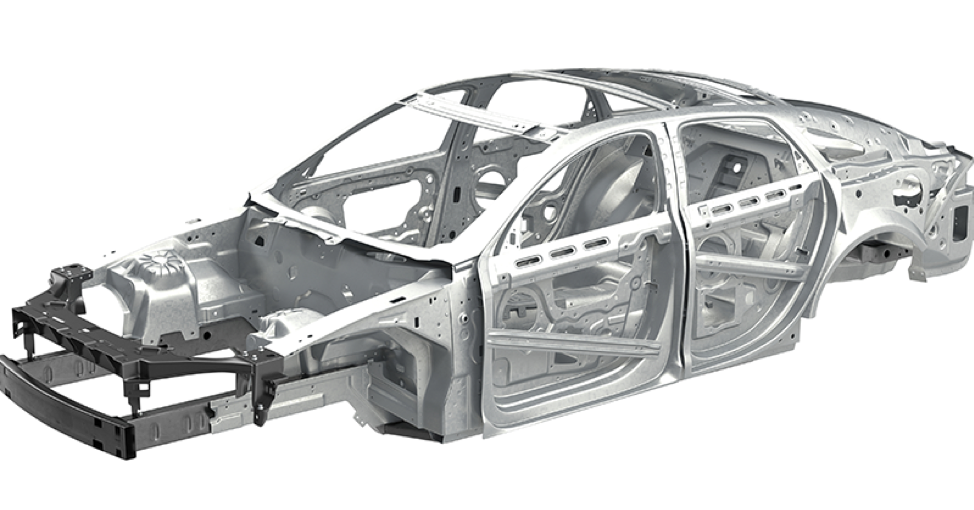
There are several common uses for steel in an automotive vehicle. Most of this steel is found in the skeletal body of the vehicle, often called the “body in white,” which is the foundation from which the rest of the vehicle is created.

The “body in white” of a car, also known as the car frame or skeleton.

Bumpers and Reinforcements

Bumpers are some of a vehicle’s first defenses against any major impact, thus they demand a very high level of force absorption. The durability and crash resistance of high strength steels make it a great option for bumper systems. Further driving its use is the ability to employ a thinner steel, promoting additional weight savings. UHSS bumpers are typically roll formed. For more detailed information on steel bumper systems for passenger cars and light trucks, visit this website: https://www.a-sp.org/-/media/doc/smdisteel/bumpers/smdi-steel-bumper-systems-manual-6th-edition—january-2019—final.ashx

There are many other areas of a car that need strong reinforcement. Sill reinforcements and cross-members, for instance, both require high energy absorption. Stiffness can be maintained when transitioning to thinner panels by changing the geometry of the parts. High strength steels are well suited for these forming challenges, with the reduced thickness leading to a lighter weight part.

Door Beams and Seating

Again, weight savings are a major consideration here. Side impact beams are now commonly made using the highest strength steels, leading to both increased safety and lighter weight products. While seats are not traditionally considered part of the Body-in-White, they are some of the heaviest items in a passenger vehicle. As such, they are prime candidates for lightweighting using high strength and durable steels.

Chassis and Frames

High-strength steel benefits the entire frame’s support capabilities. The chassis is subject to some of the most extreme stresses seen on any of a car’s parts, so it needs excellent fatigue resistance properties – such as those found in high-quality steel. Using high strength, high formability steels allows the vehicle designer the flexibility to create lightweight complex shapes while maintaining the structural integrity demanded by the application.

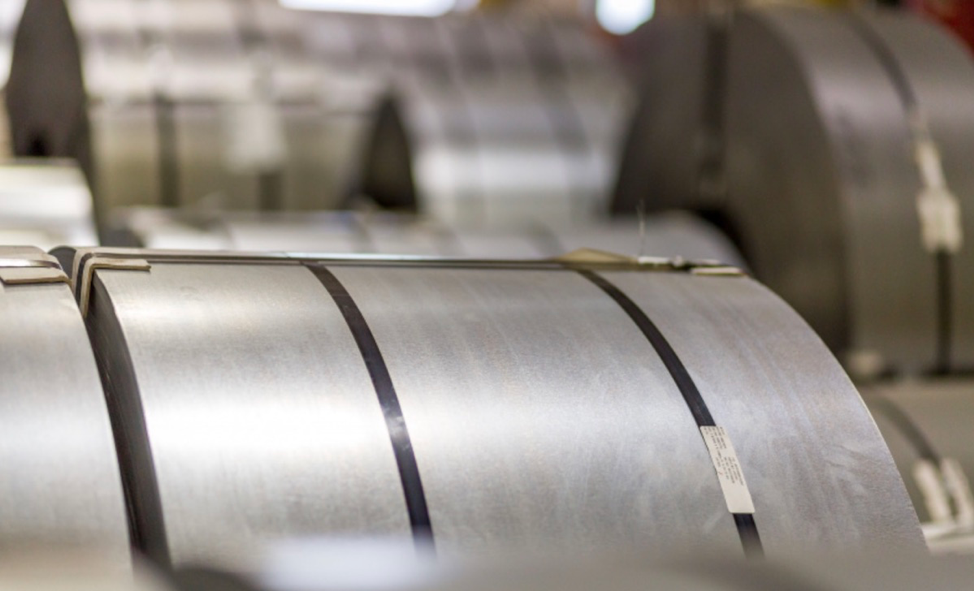
Rolls steel coils presented in an artistic way, with the coils in the foreground and background blurred out, favoring a sharp image of a shiny coil in the middle.


Advanced High Strength Steel

Forbes.com recently cited that […]

Go to Top