12 03, 2020

What is Roll Forming?

2025-02-24T19:34:21+00:00March 12th, 2020|News Blog|

Get a Custom Quote for Your Roll Forming Needs

Roll forming is a continuous process which converts sheet metal into an engineered shape using consecutive sets of mated rolls, each of which makes only incremental changes in the form.  The sum of these small changes in form is a complex profile.

The Forming Process

 In conventional stamping the entire part is formed all at the same time. The part shape – and especially how complex it can be is limited when the strains from forming exceed what the metal is capable of achieving before splitting.  In roll formed parts, only a small amount of forming strain is put into the part during each station and even here, only a small section is bent at any given time. Because of this, more complex shapes can be achieved with an appropriately designed roll forming process.

In the forming process, a coil or long individual strips are fed through a roll forming line which converts the flat sheet to a contoured cross-sectional profile. The unique aspect of this approach is the use of consecutive forming stations, each of which nudges the metal towards the desired shape.  Based on the targeted profile, a computer calculates the optimal placing and shape of the rollers for maximum efficiency and designs the track.  The more advanced the desired shape, the more rollers the material goes through. The roll forming line can bend metal, form metal into tubes, create metal maze-like structures, and punch the metal with holes during the process.
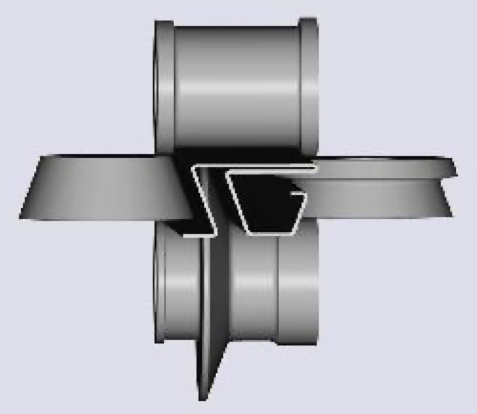
A rendered image of four grey rollers placed in a cross-pattern forming a metal profile that resembles a capital, backwards “Z” and “G” joined together at the top.

The rollers are precision-contoured metal dies that shape the incoming sheet metal. In most cases, they are also the powered drive rolls that pull the strip through the roll forming unit. These rollers can be as simple as the cylindrical rollers used to roll luggage through airport scanners, or they can take on more intricate shapes. After the final forming station, the strip is sheared to the ordered product length. Typically, no additional work is needed before shipment, since the final form has been achieved.
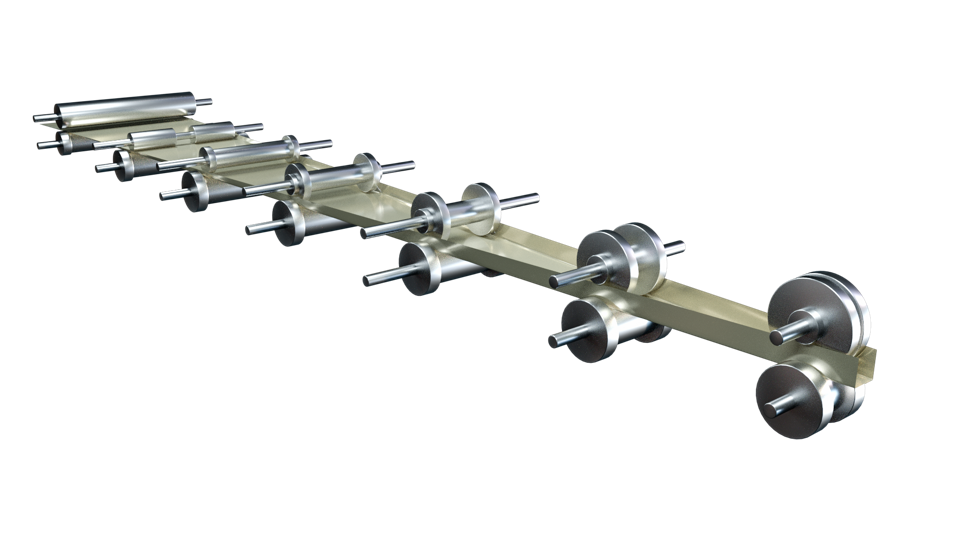
3D rendered image of a shiny steel roll former.

Advantages of the Roll Forming Process


There are a variety of advantages to roll forming. Because of the “assembly line” efficiency of roll forming, long lengths of metal can be produced and cut in large quantities, which reduces cost.  Secondary processes such as punching or even welding can be integrated into a single production line. The profiles that can be produced using roll formed sheet steel are similar to what is seen in extruded aluminum.

The roll forming process makes creating lighter-weight steel parts easier compared to other shaping processes, since the wall thickness can be targeted based on the structural needs of the component.  Parts can be rolled even if a finish or paint has been applied. While hot forming can produce similarly complex […]
8 01, 2020

Galvanized Steel in The Agricultural Industry

2020-01-15T19:15:45+00:00January 8th, 2020|News Blog|

Rows of planted crops on mounds of brown dirt that stretch towards the horizon line and meet a blue sky with clouds. In the middle of the picture are 5 white, transparent bubble logos with green designs in the middle, from right to left: a water drop, a farmer with a shovel, a tall stalk of wheat, a tractor, and a sun.

Metal and Farming:  A Perfect Match


The union of farming and metalworking has led to many of civilizations technological and agricultural developments. Before the invention of farming, most early civilizations existed as gatherers and hunters. Because farming created the conditions in which people could settle, it ultimately contributed to the building of modern society and culture. Farming, and the stability farming provided humanity, led to the benefits of modernity: technology, politics, literature, the arts, and culture. Metal, like farming, helped to tilt the balance of power between mankind and nature towards mankind. Human beings could finally subdue the natural elements around them, which, beforehand, they seemingly had little to no control over.

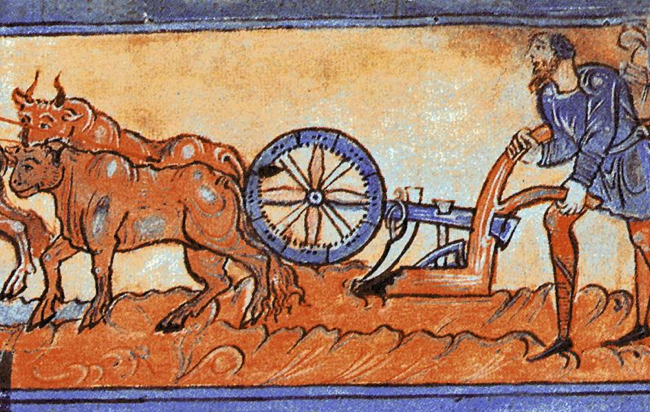
Before the union of farm work and metal, farmers had inefficient tools to contend with the harsh conditions. These medieval farms only produced somewhere between 4.34 seeds for each seed of wheat sown. Entire village populations were constantly on the brink of starvation. Metalworkers introduced the iron plow to farmers, who had been using the ineffectual wooden plow. The new iron plows could cut through the heavy northern European soil, even during winter frost. This mingling of metal and farm work, among other technological/intellectual developments, led to the Enlightenment era and a population boom that reshaped the social order.

A painting of oxen pulling a blue and brown plow across brown dirt; a bearded man in a blue tunic and brown pants follows behind, with both hands on the plow.

Today, the interaction between farming and metalworking continues to provide humanity with bountiful harvest. Although farms have become much more efficient, profit and competitive margins remain slim. Advances in metallurgy – like galvanized steel, are a keystone to modern farming operations by helping farmers to save time and money.


The Benefits of Galvanized Steel


Galvanized metal has been around for hundreds of years, although the methods for applying the zinc coating have become more sophisticated.

Galvanization improves steel’s longevity through a protective coating that prevents rust from forming. The process of hot-dip galvanizing creates a product with many benefits that other types of coatings don’t offer. For example, galvanized steel is:

  • Less expensive when compared with most treated steels.
  • Lower in maintenance cost than other coated metals – saving time on repairs and replacements.
  • Damage-resistant, very durable, and can withstand outdoor elements.
  • Self-healing in the way it’s coating provides automatic protection for damaged areas and will corrode preferentially to the steel, creating protection to the areas that are damaged.

Ready to use immediately upon delivery – it does not require additional preparation of the surface (painting/coatings, etc.) prior to installation.

A <a href= […]

30 07, 2019

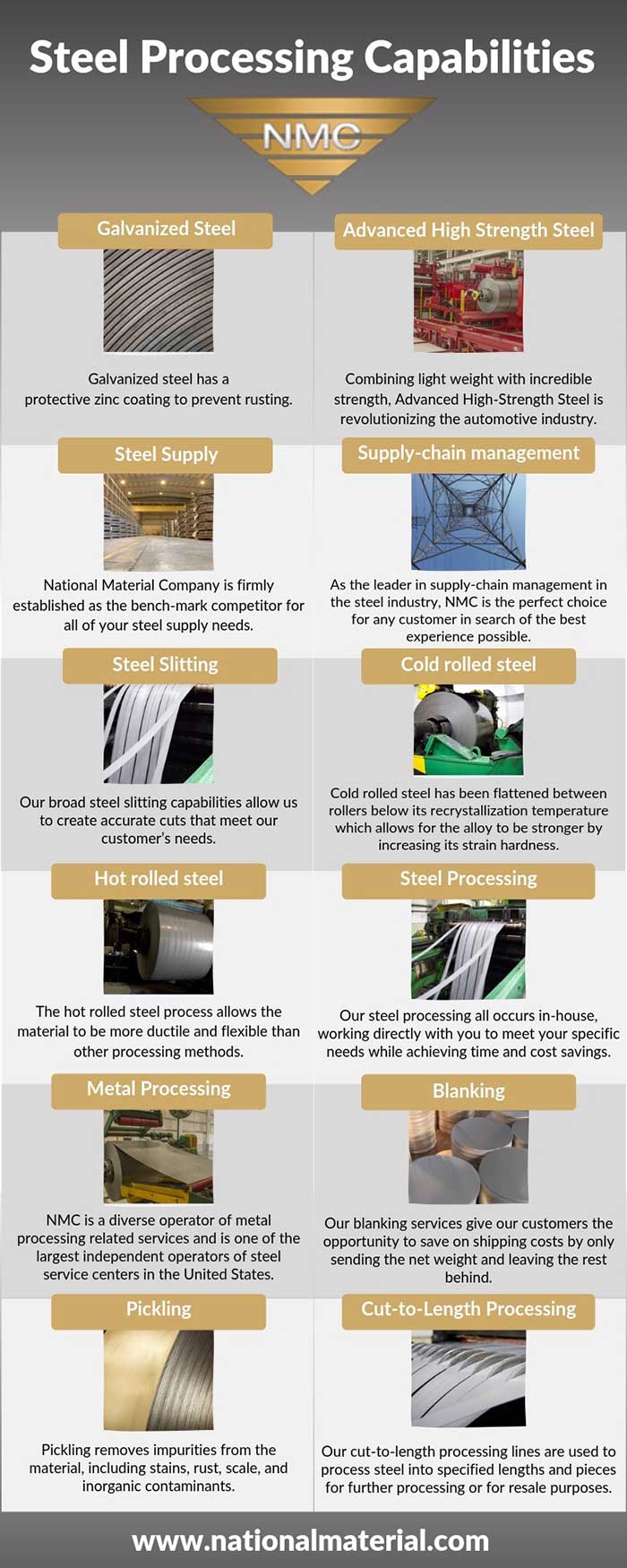
NMC’s Steel Processing Capabilities

2019-09-12T20:08:50+00:00July 30th, 2019|News Blog, NMC Media|

As the leader in steel processing capabilities, supply chain management, and inventory control, NMC is the perfect choice for any customer in search of the best experience possible. A dedicated work force, state-of-the-art slitters, cut-to-length lines and warehouse storage capabilities make NMC the premiere steel manufacturing company in North America. Locations throughout The United States and Mexico offer a logistic advantage resulting in a more efficient service to conserve our customer’s most valuable resource: cost.

NMC’s Steel Processing Capabilities Infographic

22 07, 2019

An Overview of U.S. Steel Service Center National Material L.P.

2019-09-12T18:26:00+00:00July 22nd, 2019|News Blog|

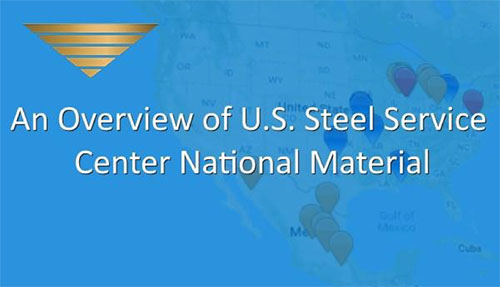
An image depicting a map of the different locations of NMLP steel service centers in the U.S, with the text An Overview of U.S. Steel Service Center National Material imposed on a blue background.

You know National Material Company as a company that specializes in supplying, servicing and processing steel with unmatched efficiency. We operate steel processing facilities and service centers throughout the U.S. and Mexico to serve your manufacturing needs in a wide variety of markets.

But the full scope of NMC’s parent company, National Material L.P, is much larger.  NMLP and its affiliates have a long history of quality and service dating back to 1964.  NMLP serves many industries throughout the globe and is one of the largest suppliers of steel in America. With over 30 business units, this families’ capabilities go beyond just steel service.

Here, we will provide a brief overview of National Material’s family of companies, separated into six categories – steel service centers, steel processing facilities, stainless steel and alloy manufacturing, aluminum manufacturing, raw material trading, and related operations.

Steel Service Centers

The NMLP Steel Group includes National Material Company, National Material of Mexico, and Interstate Steel Company. Together, these three companies have made NMLP a well-recognized leader servicing the needs of the steel industry and leading industrial and consumer product manufacturers by means of nineteen specialized processing facilities located throughout North America.

National Material Company operates ten steel service facilities and is the family’s premiere steel manufacturer in the U.S. NMC specializes in supplying, servicing and processing the following: Hot Rolled, Cold Rolled and Cold Rolled Motor Lamination Steel, Oriented and Non-Oriented Electrical Steel, and Galvanized, Galvannealed, Aluminized and other coated metals.

National Material of Mexico operates seven steel servicing locations between partners and wholly owned facilities. NMM is the premier processor in Mexico for a variety of steel products, from uncoated non-exposed to coated exposed carbon steel in slit, sheet or blank form, in all steel grades available on the market, including all types of AHSS steel grades.

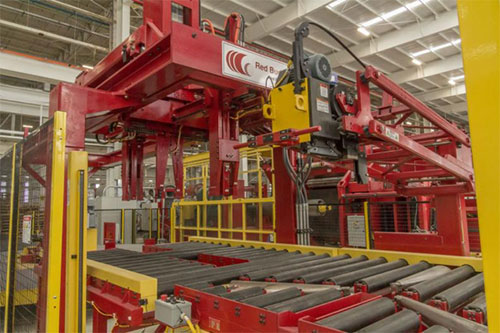
An impressive, fire-engine red piece of machinery known as a Red Bud Slitter housed in NMM’s brightly lit manufacturing facility, as part of their advanced high-strength steel slitting line.

Interstate Steel Company is a division of National Material Company and provides highly engineered pre-painted products. ISC also specializes in processed cold rolled & galvanized products. Interstate Steel’s capabilities include precision high speed slitting of surface critical products.

Steel Processing

National Material Processing operates three slitting and two pickling and cut-to-length steel processing facilities and was the first steel processor to introduce a push-pull pickle line in the Indiana Harbor area. NMP specializes in the processing of heavy gauge, hot rolled carbon steel up to .500″ (1.27cm) thick and offers precision slitting, cut-to-length and advanced PRO-ECO, hydrochloric acid pickling services.

Interstate Steel Processing (ISP) is a premier national distributor of flat rolled steel […]

24 06, 2019

10 Fun Facts You Didn’t Know About American Steel and the Steel Industry

2019-09-12T18:25:28+00:00June 24th, 2019|News Blog|

Clark Kent shedding his businessman persona he pulls his business suit away from his chest, exposing the powerful man of steel - Superman’s signature “S” logo

Looking up at the giant lattice-shell steel art structure known as the “Geodesic Dome” outside Montreal environmental museum “The Biosphere” on a clear blue skied day.

After achieving the mass production of steel, American steel industrialists pushed steelmaking to greater innovative levels. By the year 1920, 60 million tons of American steel were circulating around the world annually, making the United States the biggest global player in the steel service industry. Steel processing became a bulwark of the economy, engraving itself into the nation’s identity.

Today, National Material Company carries on the metal service and steel processing tradition. With the following 10 little-known facts, we salute those who paved the way by transforming the world through metal work.

  1. The Man of Steel could have been the Man of Tungsten.

But that doesn’t exactly roll off the tongue, now does it? According to Thaddeus Howze — author, editor, podcaster,  and self-proclaimed answer-man on all things comics –Superman got the name Man of Steel because steel was the most common of the strong metals: Steel, Titanium, Tungsten and Inconel. (It may also have something to do with the fact that “Man of Steel” is much snappier than its clunky counterparts.)

Superman was created to symbolize the extraordinary capacity of the everyday man. Thus, steel won out as metal of choice because of the household name it had made for itself, thanks to the wide proliferation of the steel industry at the time.

“Superman was a ‘man of steel’ stronger than anything you could imagine, and yet something as close as the building you were standing in or the car you desired and one day hope to own […] Steel was everywhere and steel was the king of industrial metals during this period [1940]. Steel wasn’t just the metal of tomorrow; it was also the metal of yesterday. Places in the world that had developed steel before modern industries had long-lasting cultures and it was the development of steel which made the industrial age what it was.”( Source: Quora)

2. Showers, Star Wars memes, and steel.

The month of May is well-known for its rain showers. And Star Wars enthusiasts rejoice on May the Fourth Be with You. And let’s not forget – steel.

Yes, that’s right. In the 1960s, as the nation infused steel into its structure and character, Lyndon Johnson saw it fit to raise a pedestal for steel in the pantheon of American achievement.  Therefore, he designated May as a national month for celebrating the steel industry.

“Steel is the core of industrial America. It has helped to make American productivity and technology the wonder of the world. This vital product which we produce in unmatched abundance is basic to our economy and essential to our security. It supports our buildings, spans our rivers, arms our fighting men. It […]

Go to Top