
9 06, 2026

Precision Metal Processing Improves OEM Production Efficiency

2026-06-09T04:23:27+00:00June 9th, 2026|News Blog, NMC Media|

Key Takeaways:

  • OEMs often face inefficiencies from material waste, inconsistent quality, and production delays.

  • Consolidating aluminum and steel processing with a single-source partner simplifies logistics and strengthens supply chain reliability.
  • Value-added metal services, like slitting and cut-to-length, enhance performance while lowering operational costs and risk.

Request a Quote with a Trusted Metal Service Center

Precision metal processing for OEMs is the fulcrum of modern manufacturing, where rising labor costs, up 1.1% through late 2025, have made the quality of incoming material a defining factor in whether an assembly line operates as a profit center or a bottleneck. As a result, this process serves as a form of supply chain optimization, where variables like scrap and rework are removed before they ever reach your facility. By shifting to a single-source metal procurement model, logistical friction from managing multiple vendors can be reduced, allowing operations to run more smoothly. In turn, this article explores why custom metal processing has become a necessity and how a strategic operator delivers value through high-speed slitting, cut-to-length, and advanced value-added services, all to ensure your line never stops due to preventable material failures upstream.

The Financial Logic of High-Tolerance Processing

In the world of high-speed stampingand CNC machining, “close enough” is an expensive mistake. When a coil enters a press, any deviation in gauge or edge quality stops the clock. For engineers, the real value of precision metal processing for OEMs is the elimination of these specific mechanical risks. If a coil shows a crown or inconsistent camber, your parts fail inspection, and your scrap rates skyrocket.

High-tolerance slitting and precision leveling are forms of financial risk management. Recent Bureau of Labor Statistics (BLS) productivity data shows that while manufacturing productivity increased 3.7% in late 2025, firms are still battling rising compensation costs. The only way to win is to ensure every pound of material bought is “ready-to-assemble.” By utilizing material processed to exact technical standards like ISO 9001 and IATF 16949, an OEM bypasses the hidden costs of manufacturing. Therefore, you save the hours typically spent on machine recalibration and avoid the tool wear caused by poor edge quality.

Consolidating Aluminum and Steel Under One Roof

The North American industrial landscape is converging. As the EV shift accelerates, procurement teams now manage advanced high-strength steel (AHSS) and lightweight aluminum alloys side-by-side. Managing these through separate, siloed channels is a recipe for administrative bloat.

Working with a provider that handles both aluminum and steel processing offers a massive “lower risk” profile. An integrated approach simplifies logistics by providing one point of accountability. In the current 2026 trade climate, where global […]
20 06, 2019

NMC Partner Taber Extrusions Offers Friction Stir Welding

2020-04-01T21:25:09+00:00June 20th, 2019|News Blog|

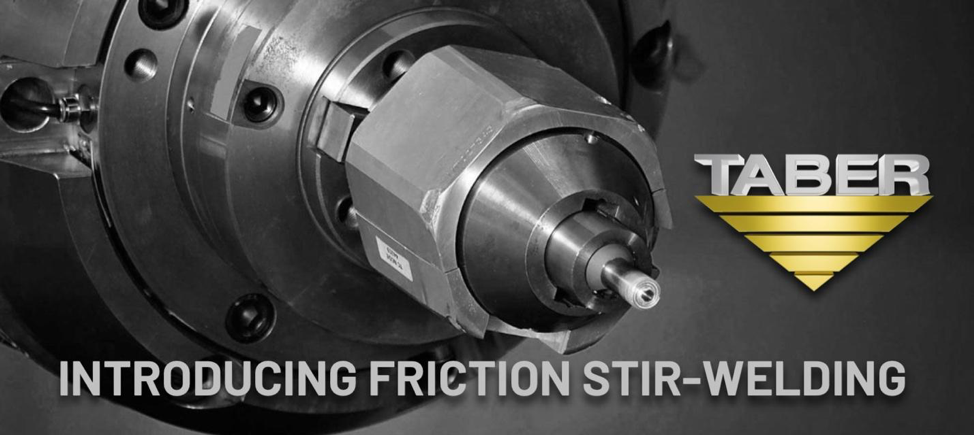
Black and white closeup image of the tip of a friction stir-welder, which resembles the tip of a drill, with Taber Extrusions’ official inverted gold triangle logo and the words, “Introducing Friction Stir-Welding.”

National Material partner Taber Extrusions of Russellville, AR. and Gulfport, MS. have announced the addition of Friction Stir-Welding capabilities to their existing portfolio, which currently includes aluminum extrusions, fabrication, billet casting, and micro-extrusions.

The addition of in-house FSW capabilities positions Taber as a vertically integrated supplier of FSW panels and assemblies previously unseen in North America. This new technology allows for finished product applications in military, bridge building, railroad refrigerated containers, and more – and brings with it the technological capacities to develop new products.

Eric Angermeier, President of Taber Extrusions, says:

Besides the additional jobs and revenue this expansion will bring to our central Arkansas community, we are very much looking forward to Taber’s new horizons into technology and product development. The welder will be housed in a new 60,000 square foot expansion to our current Russellville facility. This equipment further promotes our strategy of moving Taber toward being a solutions-oriented company offering highly engineered products.

This Friction Stir-Welder, with the latest technology, is purposely built for the long, wide extrusions being produced on our current extrusion presses. This process gives us the added benefit of vertical integration allowing us to not only better serve our existing customers, but gives us the opportunity to develop new markets and products.

Sometimes described as more of a forging process than actual welding, Friction Stir-Welding is a solid-state joining technique used to combine metals not easily fused with traditional welding. Ideal for metals such as aluminum, copper and other metal alloys, FSW is commonly used in the aerospace, rail, automotive, shipbuilding, transportation and marine industries. Friction Stir-Welding makes possible high-quality welds with minimal distortion. It is also a process that can be easily automated, making it an ideal solution for industrial use.

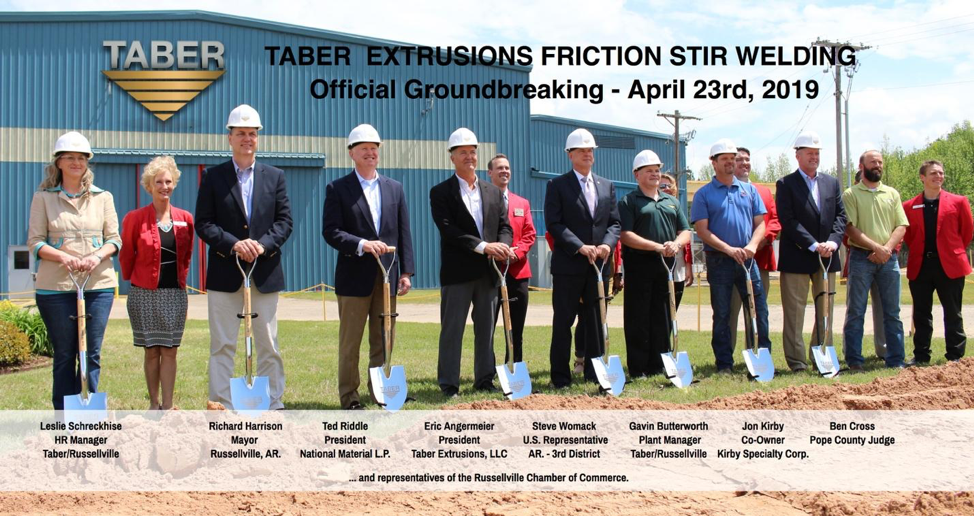
Individuals at Taber’s groundbreaking ceremony, sporting white hardhats and posing with shovels on a sunny day at the Taber Extrusions Russellville, Arkansas facility.

Taber Extrusions recently hosted a ground-breaking ceremony which included State Representative Steve Womack amongst other state and local leaders.

Congressman Steve Womack described how he sees Taber’s role from a national perspective, “The expansion of an existing company such as Taber Extrusions means a lot more than the location of a new company. It means that Taber is in the right place and has what it needs to succeed. Taber plays an important role in the defense of our nation with products that are an asset to our defense capabilities.”

Taber historically provides for many industries, including aerospace, shipbuilding, infrastructure, automotive, as well as military and defense.

Taber is already known for their wide range of capabilities, both broad and unique, and Mayor of Russellville Richard Harris thanked Taber for choosing Russellville as their location, “The fact that you chose to expand and add new technology here is the highest compliment […]

Go to Top