
Key Takeaways:
- Global volatility and tighter OEM requirements are exposing the risks of offshore metal stamping. Rising tolerance demands, accelerated programs, and fractured supply chains make domestic sourcing a strategic necessity.
- S.-based metal stamping enables the repeatability, speed, and engineering responsiveness high-volume programs require. Localized partners improve quality control, reduce lead-time risk, and support real-time tooling adjustments for complex geometries and lightweighting needs.
- NMC strengthens this domestic advantage by stabilizing material quality before it reaches the press. With precise gauge control, consistent metallurgy, and engineering tools that optimize coil specs, NMC ensures progressive die stamping runs efficiently and reliably across modern EV, infrastructure, and industrial programs.
Metal stamping is increasingly viewed as a core driver of U.S. production as OEMs push for tighter tolerances and lighter components. When programs accelerate or offshore supply chains falter, the repeatability of progressive die stamping is relied on to keep schedules intact. As a result, domestic metal stamping services in the USA are now treated as a strategic necessity rather than a simple logistical choice. High-volume demand from automotive, electronics, and infrastructure sectors has further reshaped how sourcing decisions are made. Consequently, manufacturers are being pushed to partner with teams capable of advanced tooling, rapid scalability, and true supply chain resilience.
The Operational Case for Domestic Metal Stamping
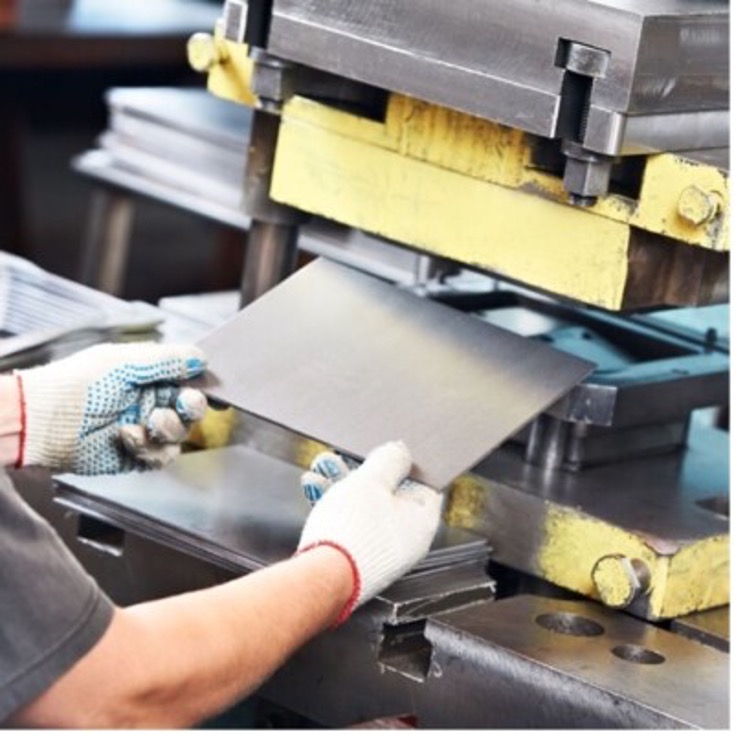
American manufacturing metal stamping remains central because it provides the stability and cycle speeds required for high-volume programs. Once tooling is finalized, progressive die stamping is relied upon to produce millions of identical cycles with negligible variation. Consequently, this repeatability has made it the preferred method for automotive systems, industrial assemblies, and electronic housings, as real-world metal stamping applications continue to show its ubiquity across critical sectors.
In addition, sector stability is closely aligned with broader U.S. industrial output. Data from the Bureau of Labor Statistics indicates that the metal stamping and forging sector (NAICS 332) is supported by a workforce exceeding 60,000, while Federal Reserve production indices further confirm a consistent correlation between stamping output and overall manufacturing cycles.
Moreover, OEMs routinely turn to stamping to meet lightweighting targets without compromising structural integrity. The ability to form complex geometries allows mass to be reduced while performance standards are preserved, and modern stamping lines are still well-suited for high-strength steels and corrosion-resistant alloys as material technologies advance. For readers seeking a more detailed breakdown of how these variables interact during production, this technical analysis of the metal stamping process may be reviewed.
Metal Stamping and Supply Chain Resilience
Global logistics volatility has increasingly compelled OEMs to reconfigure sourcing strategies. As extended lead times and offshore bottlenecks are weighed against marginal cost savings, the shift toward domestic partners for critical components is becoming more pronounced. In fact, IBISWorld’s market analysis notes that U.S.-based stamping facilities are valued for stronger regulatory compliance and faster engineering responsiveness. Because geographic proximity enables real-time technical intervention, tooling issues involving spring back, draw quality, or die wear can be addressed immediately, whereas time zone delays often hinder such adjustments in cross-border partnerships.
Additionally, the U.S. Census Bureau classification (NAICS 33211) reinforces the sector’s role as a foundational element of the industrial economy. Beyond regulatory alignment, further benefits are realized through localized material control, as procurement teams gain direct oversight of coil quality and processing timelines. As a result, volume planning can be more accurately synchronized with production demands.
Growth Drivers: EVs, Infrastructure, and Lightweighting
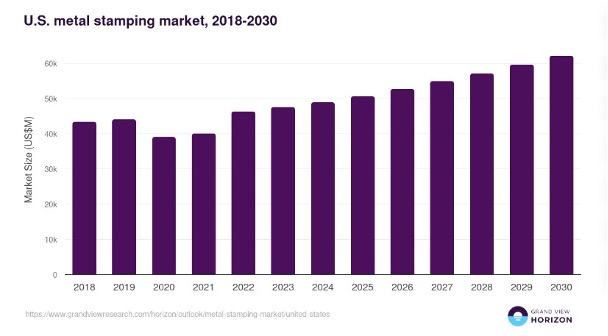
Current forecasts indicate that the American metal stamping market is expected to expand from roughly $47.5 billion in 2023 to more than $62 billion by 2030. This growth is being driven by demand from capital-intensive sectors such as EVs, construction, and industrial machinery, where scalable high-volume metal stamping is increasingly required.
EV platforms require specialized stamped components for battery enclosures, thermal interfaces, and powertrain shielding. According to a market analysis of automotive metal stamping in the USA, electrification is reshaping procurement strategies as demand shifts toward complex, tight-tolerance geometries. At the same time, infrastructure investment is driving higher volumes of structural fastening components, while electronics manufacturers continue to rely on precision metal stamping for increasingly miniaturized housings.
Moreover, lightweighting remains a primary engineering directive. When incremental mass reductions are scaled across millions of units, substantial gains in unit cost and vehicle range can be achieved. As a result, lightweight metal components stamping is often favored, as it allows high-strength-to-weight materials to be utilized in ways that alternative fabrication methods cannot efficiently support.
How NMC Supports Modern Stamping Requirements
Metal stamping remains essential, as stable throughput, predictable costs, and consistent quality are demanded by OEMs across long-running programs. As supply chain strategies increasingly shift toward domestic sourcing, tighter control, faster collaboration, and stronger production continuity are provided by U.S.-based partners.
National Material Company (NMC) is aligned with these requirements through integrated metal processing capabilities that stabilize material quality upstream. By ensuring that precise gauge control and metallurgical consistency are maintained before the coil reaches the press, variability in high-volume progressive die applications is minimized. This technical expertise is leveraged to support lightweighting initiatives, EV expansion, and infrastructure programs where material integrity cannot be compromised.